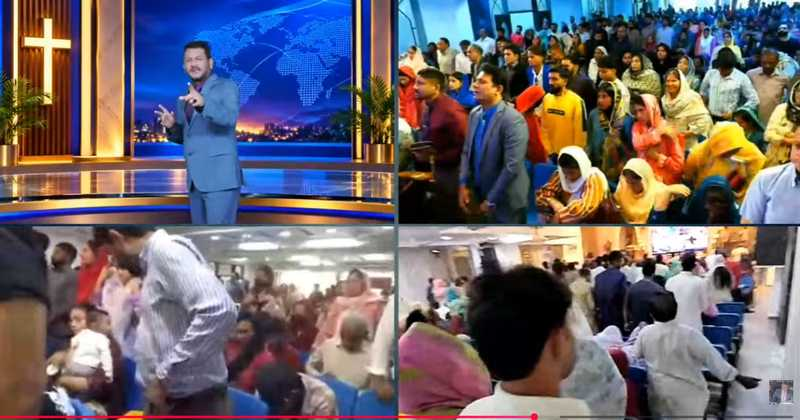
Use what God has placed in your hand.
Adapted from a live message preached in Urdu, Punjabi and Hindi. Scripture references and chapter divisions have been added for clear, engaging reading.
Editorial note: This is a polished reading edition, not a verbatim transcription. The ministry needs described below reflect the time of the original message; please refer to the official donation page for current giving information.
The Source of Blessing
James 1:17 · Philippians 4:11–13Beloved brothers and sisters, use what God has given you. When you begin to use it, trust Him to guide and bless the work of your hands. The promise of blessing is not ultimately controlled by the east or the west, by your circumstances, or by the approval of other people. We look to God, the One from whom every good gift comes. (See Psalm 75:6–7; James 1:17.)
Some of you have stopped doing what God placed in your hearts. Perhaps you tried once and became discouraged. Perhaps someone laughed at your effort. Perhaps fear whispered, “You will fail.” If so, come before God honestly. Ask His forgiveness where you have neglected your calling, and ask Him for the courage to begin again.
Say to the Lord: “I was afraid. I thought it would not work. I believed I did not have enough strength. But today I choose to remember that You are with me.”
The apostle Paul spoke these words in the midst of learning contentment through every kind of circumstance. They are not a promise that every plan will succeed exactly as we imagine. They are a declaration that Christ gives strength to remain faithful, courageous, and obedient. Let that confidence change the way you see your work, your family, and your future.
Lift your heart to God and pray: “Lord, bless me—not merely so that I may gain more, but so that my life may honor You and become a blessing to others.”
Stop Calling Your Gift Insignificant
1 Peter 4:10 · 2 Timothy 1:6The world often measures people by wealth, position, education, or public recognition. A person may possess a useful skill and yet hear others call it ordinary, weak, or worthless. Even close friends or family may fail to recognize the potential in what God has entrusted to someone.
But the worth of your calling does not depend upon the applause of the crowd. If God has entrusted you with a responsibility, do not despise it because it appears small. A gift does not have to be famous to be faithful. Service does not have to be visible to be valuable.
Perhaps your gift is teaching children, writing, making something with your hands, caring for the sick, leading worship, repairing equipment, praying for others, organizing a ministry, or speaking a word of hope to a discouraged neighbor. Offer it to God. Develop it with discipline. Use it with humility.
Pray: “Lord, people may think this work is insignificant, but You know why You called me. You taught me, strengthened me, and opened the way. Now use this gift for Your glory.”
David: A Sling in God’s Hands
1 Samuel 17:28–50Consider David. When he faced Goliath, he did not begin with the equipment of a warrior. He came with the familiar tools of a shepherd: a sling and stones. The stone itself was not a source of magical power. David’s confidence was in the living God, and he acted with the ability he had faithfully developed. (1 Samuel 17:40–50.)
Even David’s own brother questioned his motives, and King Saul doubted whether a young shepherd could face an experienced warrior. David had reasons to be discouraged, yet he did not surrender his calling to their judgment. He remembered the faithfulness of God in earlier battles.
Do not ask first whether your gift looks impressive beside someone else’s. Ask whether you are being faithful with what is in your hand. A simple instrument, combined with courage, preparation, and trust in God, can serve an extraordinary purpose.
Moses: The Ordinary Staff
Exodus 4:1–12 · Acts 7:22When the Lord called Moses, Moses saw his own weaknesses. He worried about how people would receive him and protested that he was not an eloquent speaker. God did not deny that Moses felt inadequate. Instead, He called Moses to obedience and promised to be with him. (Exodus 4:1–12.)
Then God asked him a simple question: “What is that in your hand?” Moses answered that it was a staff. It was an ordinary object—something he used in daily life. Yet that staff became a sign through which God demonstrated His power.
The lesson is not that objects possess power in themselves. The lesson is that God is not limited by our assessment of our resources. What looks ordinary in human eyes can become useful when surrendered to His purpose.
You may say, “I cannot speak. I do not have money. I have never done this before. I do not know the right people.” Remember Moses. Bring your fears to God, accept the help He provides, and take the next step of obedience.
Shamgar: One Farmer’s Tool
Judges 3:31Scripture also introduces Shamgar, who struck down six hundred Philistines with an oxgoad—a farming implement used to guide animals—and delivered Israel. (Judges 3:31.) We are told very little about him, but this brief account carries a memorable lesson.
He did not appear equipped with the weapons of a conventional army. He had an implement associated with ordinary work. Yet the biblical account remembers him as an instrument of deliverance.
Some people see only limitations: “I have a small business. I am a farmer. I have one talent. My resources are few.” God sees a person who may be willing to serve. It is not wise to measure the possibilities of your life only by the tools you possess today.
Whether your skill is great or small, polished or still developing, do not bury it in shame. Learn, practice, grow, and make it available for good.
Beyond Your Own Household
Genesis 12:2–3When God blesses your gifts and your service, the fruit can extend beyond your own family. Your children may be encouraged by your example. Other believers may be strengthened. Neighbors may find hope. People you have never met may be touched by the message you carry.
God’s purpose in blessing Abraham was not limited to Abraham himself; through him, blessing would reach many families of the earth. (Genesis 12:2–3.) In the same way, we should seek blessings that overflow into service, discipleship, compassion, and witness.
Do not make the opinion of your parents, siblings, friends, or even your pastor the final measure of your worth. Honor others, accept wise counsel, and remain accountable—but remember that God is the giver of life and calling. His grace is not held captive by human praise or criticism.
I believe God desires to renew our thinking. Fear says, “I cannot.” Faith asks, “Lord, what would You have me do with what I already have?” A changed mind leads to changed choices, and changed choices open the door to faithful action.
From Fear to Faithful Action
Matthew 25:14–30Let us be honest about the excuses we sometimes make. We delay because we want perfect conditions. We compare ourselves with others. We remember a disappointment and imagine that it must define our future. We set a gift aside, not because God has taken it away, but because discouragement has become louder than our calling.
Today you can make a different decision. If you need to repent, repent. If you need to forgive someone, begin that work. If you need to learn, study. If you need to practice, make room for it. If you need to ask for support, ask with humility. And if you need to start again, take the first step.
Faith is not passive. David picked up stones. Moses obeyed. Shamgar acted. In each story, trust in God was joined to a response. Do not simply speak about your purpose; begin to live it.
A Personal Testimony: Learning, Writing, Serving
Personal testimonyAllow me to share something from my own life. I have carried a passion for writing and communicating God’s Word for many years. My first book was published in 1997, and over time I continued the work of writing and publishing. The journey has not always been easy. People have told me that a particular project would require more money, more resources, or costly professional help than I could provide.
For months, I devoted long hours to learning new skills. I studied how to prepare, translate, and publish material. There were difficult days and nights of exhausting effort. Yet I discovered that some of the abilities I needed were already within reach if I would take the time to develop them.
At the time of this message, an English-language book had been released, another had been printed, and I was preparing to share more teaching and preaching in English. These steps were not simply about producing books. They were about refusing to abandon the mission God had placed on my heart.
People often ask, “How much did it cost you to publish?” My answer was surprising to some: I did not pay an upfront publishing fee for those books, and I had not received a donation for that publishing work. I arranged publishing agreements with companies, including services that make books available through Amazon and other outlets. I learned to use the opportunities available to me.
I share this not to suggest that every project can be completed without expense. Many worthy projects require resources. I share it because we sometimes search endlessly for what we lack while neglecting what we can learn, develop, and do today. God can open unexpected doors as we work with diligence and faith.
Never forget your mission. Your circumstances may change, your methods may change, and your audience may grow; but the call to be faithful remains.
Generosity That Carries the Message
1 Kings 17:8–16 · Mark 12:41–44There is also a practical need in the life of the church. At the time of this sermon, The Church of Pentecost Pakistan was renting cameras for its services and ministry broadcasts on a recurring basis. Existing cameras had been damaged, and two computers had also been lost following electrical problems. These needs affected the church’s ability to record, share, and distribute the message.
So I appealed to fellow believers, especially overseas Pakistanis, businesspeople, and friends of the ministry: If these messages have encouraged you, prayerfully consider helping us obtain cameras and computers. Such support can strengthen our media work and enable more people to hear the Word of God.
Sometimes people express their appreciation for a sermon and say how much it means to them. Those words encourage a pastor. But we also need willing hands and generous hearts to make the ministry possible. The church’s work is carried forward through prayer, faithful service, offerings, and responsible stewardship.
What can a small gift accomplish?
Remember the widow who shared her small supply of flour and oil during the days of Elijah (1 Kings 17:8–16). Remember also the poor widow whom Jesus noticed as she gave two small coins (Mark 12:41–44). Jesus praised not the size of her gift but the generosity and sacrifice of her heart.
The value of an offering is not measured only by its amount. A person with much can give generously; a person with little can also give meaningfully. No one should be pressured to give beyond their ability. We give freely, wisely, and for the glory of God.
Working together for the gospel
The church’s website, coppak.org, was developed to share news, ministry activities, and updates. I expressed particular gratitude to Brother Sam Sohotra and the Genius Fixers team for helping to complete the project and continuing to support the media work. Their contribution is an example of using professional skills in service of a larger mission.
To those who wish to support this ministry, the original appeal mentioned Interac e-Transfer (churchofpentecost@gmail.com), JazzCash (+92 300 417 9633), Western Union, MoneyGram, and PayPal. These details are reproduced from the spoken message for completeness; please confirm that they are current and authorized through the church’s official communication channels before sending a contribution.
Whether your contribution is financial, technical, practical, or prayerful, offer it sincerely. Let our gifts become instruments of hope, discipleship, and the spread of the gospel.
A Prayer of Dedication
A closing prayerHeavenly Father, I bring before You every person who is reading these words. You know those who have become discouraged, those who have made excuses, those who are disappointed, and those who have laid aside their gifts because they were afraid.
Lord, forgive us where we have failed to trust You. Renew our minds. Lift the weight of fear and give us the courage to obey. Remind us that Your grace is sufficient and that Christ strengthens us for the work You have called us to do.
Bless the abilities, talents, professions, and opportunities You have entrusted to Your people. Take what looks ordinary in our eyes and use it according to Your will. Guard us from pride when we succeed and from despair when we struggle. Teach us diligence, humility, generosity, and perseverance.
Let Your blessing not stop at the doors of our homes. May it reach our children and future generations, our neighbors and communities, and people across nations and cultures. Use our words, our work, our resources, and our witness to make Jesus Christ known.
We place our commitments and prayers before You through Jesus Christ our Lord. May every good thing done through our lives bring honor to His name. Amen.